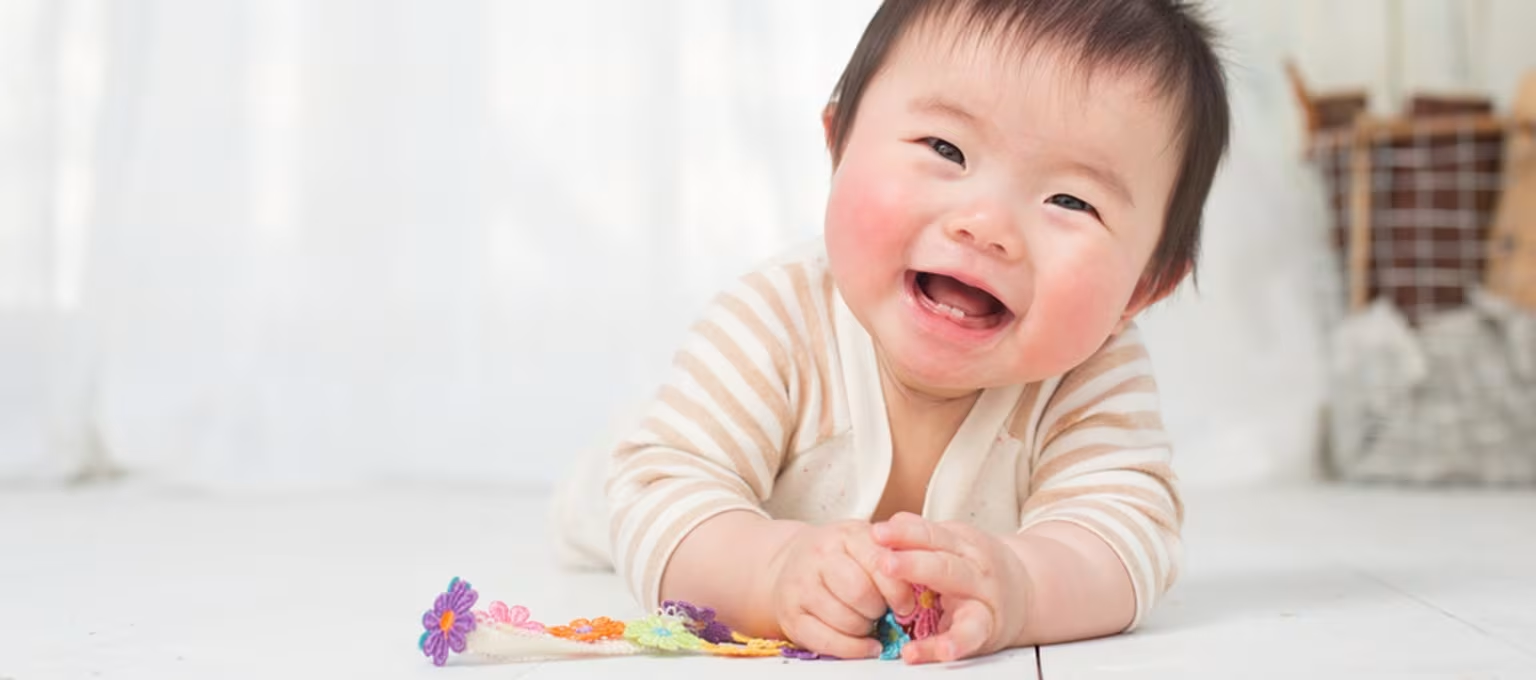
Surprise, Surprise! Babies Understand More Than We Think


Speech and language can be a very tricky part of a child’s development and something that my family has been struggling with for many years. I’ve always paid close attention to my children’s development, while trying not to overthink milestones they’ve missed or fallen behind on. I followed the baby and toddler milestones, the pediatrician’s guidance, and gladly received advice from friends and family when it came to our children’s language development. I know for our two boys, one important thing we did was to make sure we were doing our best to talk to our children. Whether it was pointing things out as we went about our day or described the chores we were doing at the moment, whatever opportunity we found, we were always talking!
Do Babies Understand Us?
At the time, I didn’t realize just how important and effective it was for us to start talking to our kids at a young age. While there has been previous research showing that babies understand common nouns at 6 months, a new study shows they understand those words much more than we thought. The study, published in the Proceedings of the National Academy of Sciences (PNAS), discovered that 6-month-old babies also recognize that the meanings of some words, like car and stroller, are more similar than others, like car and juice.
Through the PNAS study, researchers utilized eye tracking (reflecting infrared light off the baby's eyes) in order to track an infant's visual perspective when sitting in their parent’s lap while watching a video of various common objects. What they concluded was the babies had a harder time visually connecting objects that were closely related, like milk and juice. When two pictures were related, the babies spent more time looking at them, however when the two pictures were unrelated, like milk and foot, the babies spent less time looking at them. The babies' knowledge of the words correlated with the amount of time they heard people talking about the objects around them.
“The results of this study also indicate that a 6-month-old is starting to be able to categorize, which is an extremely important skill when it comes to language development and future learning. The baby knows that hat and car are very different (not in the same category) so it is easy to distinguish between which word was said. However, when the baby hears hat and coat it becomes more of a challenge to know which item is which because they are both in the category of clothing.” explains Tanya Thibodeau, former pediatric Speech-Language Pathologist turned blogger at Seeme and Liz.
So, when our children are contemplating between two related objects, they are just processing and taking it all in. In time, those babies will be able to make the deeper connection and differentiate between common, related and unrelated objects. In the meantime, it is our job to guide them with a little love, patience and the steps to grow in their further language development.

Baby Growth Chart Calculator
Keep an eye on your baby’s average growth by tracking height, weight, and head circumference with our simple tool.
This is a mandatory field.
This is a mandatory field.
This is a mandatory field.
This is a mandatory field.
*Input details of your baby’s last measurements. **Source: World Health Organization
Help Your Baby Learn to Talk
What can you do to get your baby to begin a successful path to developing their language skills? Thibodeau offers some simple suggestions and advice:
And from personal experience, it is never too late to start talking to your child or working with them to better help them. My eldest went to speech therapy for a year when he was 5-years-old and as we worked with him and his speech therapist we knew ‘better late than never’ was very true. Now, with our 20-month-old son, who is limited to less than a handful of words, we are better prepared to jump in and work with him. We’ve got this!
“It's great that studies like this are being done as they will help to show how important early intervention can be for babies/children at risk,” says Thibodeau. My family couldn’t agree more.
Related Articles

All About Separation Anxiety in Babies, Toddlers, and Older Kids
Separation anxiety can start as early as 8 months in babies and toddlers. Explore common symptoms and learn what to do when your child worries about separation.
Read more
Tips for Reducing Baby Separation Anxiety at Night
Get tips on how to support your baby with their separation at night Separation anxiety in babies at bedtime is completely normal as your baby develops and these tips can help you support them through it.
Read more
Tips for Teaching Baby Sign Language
By Christopher B. Peltier
Teach your baby sign language to communicate before speaking. Begin at 6-7 months with simple signs like “milk” and “more” for easier daily interactions.
Read more
How to Encourage Independence From a Young Age
Asking yourself how to encourage independence from a young age? Read about how you can give your child the gift of independence by following these guidelines.
Read more
Baby Talk: Understanding Your Baby
Understand your baby's sounds with this guide to baby talk! Explore milestones, from babbles to first words, and learn how to support language development.
Read more
When Do Babies Start Cooing? All About Your Baby’s First Sounds
During the first few weeks of their lives, babies start making sounds and learn to communicate. Read all about when babies start cooing, and how to encourage it.
Read more
How Positive and Proactive Discipline Can Help Change Your Child’s Behavior
Read about how to settle your child’s outbursts with four major tools: understanding power, setting boundaries, consistency and positive and proactive discipline.
Read more
True Grit: How Babies Learn to Be Persistent
Persistence isn’t a personality trait that is often associated with babies, assumed to be innately known rather than learned. A new piece of research, however, suggests that babies as young as 13 months can learn to be persistent. Read our summary of this fascinating development here.
Read more
Your 11-Month-Old's Language Development
Explore your 11-month-old's language development! Learn how many words to expect, joint attention skills, and ways to support language development.
Read more
When Do Babies Start Laughing?
Do you ever wonder when babies start laughing? Learn all about your baby’s first laugh, when it might happen, and how to encourage it.
Read moreAll About Separation Anxiety in Babies, Toddlers, and Older Kids
Separation anxiety can start as early as 8 months in babies and toddlers. Explore common symptoms and learn what to do when your child worries about separation.
Read moreTips for Reducing Baby Separation Anxiety at Night
Get tips on how to support your baby with their separation at night Separation anxiety in babies at bedtime is completely normal as your baby develops and these tips can help you support them through it.
Read moreTips for Teaching Baby Sign Language
By Christopher B. Peltier
Teach your baby sign language to communicate before speaking. Begin at 6-7 months with simple signs like “milk” and “more” for easier daily interactions.
Read moreHow to Encourage Independence From a Young Age
Asking yourself how to encourage independence from a young age? Read about how you can give your child the gift of independence by following these guidelines.
Read moreBaby Talk: Understanding Your Baby
Understand your baby's sounds with this guide to baby talk! Explore milestones, from babbles to first words, and learn how to support language development.
Read moreWhen Do Babies Start Cooing? All About Your Baby’s First Sounds
During the first few weeks of their lives, babies start making sounds and learn to communicate. Read all about when babies start cooing, and how to encourage it.
Read moreHow Positive and Proactive Discipline Can Help Change Your Child’s Behavior
Read about how to settle your child’s outbursts with four major tools: understanding power, setting boundaries, consistency and positive and proactive discipline.
Read moreTrue Grit: How Babies Learn to Be Persistent
Persistence isn’t a personality trait that is often associated with babies, assumed to be innately known rather than learned. A new piece of research, however, suggests that babies as young as 13 months can learn to be persistent. Read our summary of this fascinating development here.
Read moreJoin a World of Support
through Pregnancy and Parenthood.
TRACK WITH TOOLS
LEARN WITH EXPERTS
GET REWARDED




Where You Already Belong