Week 33
of pregnancy

You are 83% through your pregnancy, with your due date in 7 weeks
Fetal development
Height
~17 in
Weight
>4 lb
Weekly highlights
- 1Baby’s Development. Your baby is around 17 inches long and over 4 pounds, gaining about half a pound per week. Bones are hardening, though the skull stays soft and flexible for birth. All five senses are active, and pupils now react to light. Your provider may check your baby’s position and order an ultrasound if breech is suspected.
- 2Bodily Changes & Symptoms. Common symptoms include back or pelvic pressure, frequent urination, Braxton Hicks contractions, leg or foot swelling, carpal tunnel symptoms, itchy skin, and sleep challenges. Occasional cramps may occur—call your provider if contractions become regular or intense.
- 3Health & Wellness. Ease discomfort with supportive pillows, gentle stretching, hydration, and elevating your feet. Wrist braces can help with hand tingling, and moisturizing or warm baths can soothe itchy skin. Time contractions if they’re frequent, and contact your provider with concerns.
- 4Tips & To-Dos. This is a good time to practice your hospital route, pack your hospital bag, and install your rear-facing car seat. Set up your nursery, wash and organize baby clothes, and review your hospital’s options for labor and birthing positions. At your appointment, expect weight, blood pressure, urine, and fundal height checks, and ask about vaccines like Tdap.
You are 83% through your pregnancy, with your due date in 7 weeks
Checklist for week 33
- Plot and practice driving the quickest route to the hospital, timing yourself.
- Get your baby’s nursery set up and decorated.
- Find out more about breastfeeding and what resources are available to you, like classes or support groups.
- If you have a little spare time this week, sanitize your baby gear and wash your baby’s clothes, bedding, and swaddle blankets.
- Organize your baby’s clothes by size. This makes it easier for you to find what you’re looking for no matter what size your baby is at birth and beyond.
- Check out the best baby products as voted and reviewed by thousands of Pampers Parents. You’ll find lists of the best strollers, car seats, baby bottles, and more—all in one spot.

Loyalty program
Are you starting to think about buying the first diapers for your baby?
Get exclusive recommendations and offers just for you to save hundreds of $$$ on Pampers

Get the Pampers Rewards app
At 33 weeks pregnant, you’re in the home stretch of your pregnancy, and you might be counting the weeks and days until you give birth. This article will cover some symptoms you may experience in the last few weeks of pregnancy, outline the developmental changes your baby is making at 33 weeks pregnant, and offer some tips on how to stay healthy and comfortable during this period.
Highlights at 33 Weeks Pregnant
Check out these highlights and insights for 33 weeks pregnant:
Have you picked out any baby names for your little one yet? If not, take advantage of our Baby Name Generator:
33 Weeks Pregnant: Your Baby’s Development
Here are some of your baby’s amazing developments at 33 weeks pregnant:
How Many Months Is 33 Weeks Pregnant?
So, what is 33 weeks pregnant in months? You’re likely in your eighth month at this point—there are a couple of different ways to group the weeks of pregnancy into months, so this can vary.
Baby's Size at 33 Weeks Pregnant
How big is your baby at 33 weeks? This week, the average baby is about the size of a small pineapple, and your little one is putting on weight quickly now, about a half pound a week. Though, at the end of the previous week, your baby may have weighed more than 4 pounds. And, they’re likely measuring around 17 inches in length.
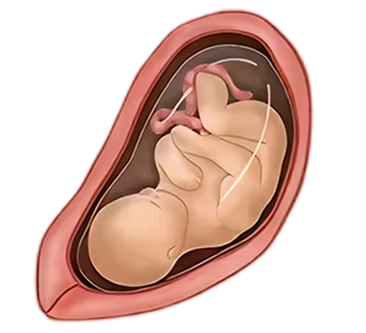
Your Baby: What Does 33 Weeks Pregnant Look Like?
See below for an illustration of what your little one might look like at 33 weeks gestation.
Your Body at 33 Weeks Pregnant
At this point in your pregnancy, you may find that sleep is eluding you. With your increased size and protruding belly, at 33 weeks pregnant, sleeping through the night may be more difficult, which might leave you feeling exhausted.
Try to make your bed as comfortable as possible, adding pillows for your legs and abdomen. To feel a little more rested, take daytime naps whenever possible.
Lower back pain and pelvic pressure may be a cause of discomfort around 33 weeks pregnant due to the size of your belly. If your baby has “dropped” into a lower position in your pelvis, this can lead to increased pressure not only in the pelvic area but in the hips and bladder.
You can do some gentle backbends to help ease the discomfort: As you stand upright, place your hands on your back and bend slightly backward (about 15 to 20 degrees). Repeat this movement a few times, as needed.
Consult your healthcare provider for more information on how to exercise and stretch your back and for other ways to reduce or manage back pain.
33 Weeks Pregnant: Your Symptoms
Here are some common symptoms that you may be experiencing around 33 weeks pregnant:
How Big Is a Pregnant Belly at 33 Weeks?
Your growing baby means that your uterus is also expanding. If your fundal height was measured at 33 weeks, it would likely be around 13 inches (33 centimeters)—from the top of your pubic bone to the top of your uterus. But remember, every pregnancy bump is different!
You may even begin to feel more pressure in your lower body as your baby starts to settle into a lower position in your pelvis around 33 weeks pregnant or in the next few weeks.
What Does 33 Weeks Pregnant Look Like?
Check out our visual below for a better idea of how your pregnancy bump may look around 33 weeks, in your eighth month.
33 Weeks Pregnant: Things to Consider
From birthing positions to car seats, there are many things to consider and take care of during this period:
Tip for Partners If you drive a car, have you purchased and installed your baby’s car seat? Now might be a good time to read about the necessary requirements and how to properly install a car seat for babies—you’ll be an expert in no time! You can find more information in the above section (Things to Consider). |
33 Weeks Pregnant: Questions for Your Healthcare Provider
Your healthcare provider is always there to answer any questions you may have throughout your pregnancy. The following are some common questions that crop up at 33 weeks pregnant:
FAQS AT A GLANCE
At 33 weeks pregnant and throughout your entire pregnancy for that matter, maintaining a healthy lifestyle is recommended. This may include eating a healthy diet, exercising, and eliminating bad habits that can harm your baby, such as smoking and alcohol.
In the third trimester, you may feel fatigue and discomfort due to your large bump. Try not to overdo it and avoid any heavy lifting or strenuous activities.
How We Wrote This Article The information in this article is based on the expert advice found in trusted medical and government sources, such as the American Academy of Pediatrics and the American College of Obstetricians and Gynecologists. You can find a full list of sources used for this article below. The content on this page should not replace professional medical advice. Always consult medical professionals for full diagnosis and treatment.
- American College of Obstetricians and Gynecologists. Your Pregnancy and Childbirth: Month to Month, 6th ed. (Washington, DC: American College of Obstetricians and Gynecologists, 2015).
- American College of Obstetricians and Gynecologists. Your Pregnancy and Childbirth: Month to Month, 7th ed. (Washington, DC: American College of Obstetricians and Gynecologists, 2021).
- Mayo Clinic. Guide to a Healthy Pregnancy, 2nd ed. (Rochester, MN: Mayo Clinic Press, 2018).
- Cleveland Clinic. “Fundal Height.”
- Kids Health. “Week 33.”
- Mayo Clinic. “Baby Soft Spots.”
- Mayo Clinic. “Pregnancy Week by Week.”
- Womens Health. “Breastfeeding.”
Week 27
At 27 weeks pregnant, your baby’s heart rate may slow down when they hear your voice. Learn all baby development and your symptoms at 27 weeks pregnant.
Read more
Week 14
At 14 weeks, your fetus is developing a sense of taste and smell. Find out more about baby development, and common pregnancy symptoms at 14 weeks pregnant.
Read more
Week 15
Discover the most common pregnancy symptoms at 15 weeks pregnant, and all the exciting ways your fetus is developing this week.
Read more
Week 16
At 16 weeks pregnant, you may have an ultrasound where you could learn your baby’s gender. Discover more about this exciting week of pregnancy.
Read more
Week 20
By 20 weeks pregnant you may have found out the gender of your baby via an ultrasound. Learn more about what takes place at 20 weeks.
Read more
Week 11
At 11 weeks pregnant, you might be experiencing some unusual food cravings. Find out why this happens and catch up on baby development at 11 weeks.
Read more
Week 13
At 13 weeks pregnant, you’ve almost made it to the “honeymoon” period of pregnancy—the second trimester. Find out what else is exciting about this pregnancy week.
Read more
Week 12
At 12 weeks pregnant, there’s a lot going on with your baby’s development and your body. Read on to learn about what happens during this week of pregnancy.
Read more
Week 34
At 34 weeks, you might feel more pressure on your pelvis as your baby drops down. Read on for more about what might happen during this week of pregnancy.
Read more
Weeks 1 to 2
Will you really notice those very early signs of pregnancy in weeks 1 to 2? Read on to learn what’s happening in your body at the start of your pregnancy.
Read moreWeek 27
At 27 weeks pregnant, your baby’s heart rate may slow down when they hear your voice. Learn all baby development and your symptoms at 27 weeks pregnant.
Read moreWeek 14
At 14 weeks, your fetus is developing a sense of taste and smell. Find out more about baby development, and common pregnancy symptoms at 14 weeks pregnant.
Read moreWeek 15
Discover the most common pregnancy symptoms at 15 weeks pregnant, and all the exciting ways your fetus is developing this week.
Read moreWeek 16
At 16 weeks pregnant, you may have an ultrasound where you could learn your baby’s gender. Discover more about this exciting week of pregnancy.
Read moreWeek 20
By 20 weeks pregnant you may have found out the gender of your baby via an ultrasound. Learn more about what takes place at 20 weeks.
Read moreWeek 11
At 11 weeks pregnant, you might be experiencing some unusual food cravings. Find out why this happens and catch up on baby development at 11 weeks.
Read moreWeek 13
At 13 weeks pregnant, you’ve almost made it to the “honeymoon” period of pregnancy—the second trimester. Find out what else is exciting about this pregnancy week.
Read moreWeek 12
At 12 weeks pregnant, there’s a lot going on with your baby’s development and your body. Read on to learn about what happens during this week of pregnancy.
Read more