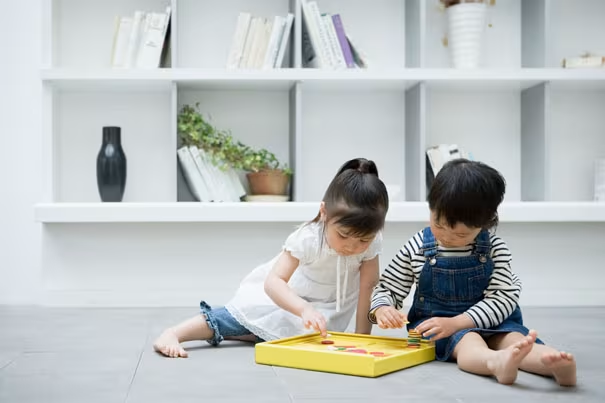
Teaching Toddlers to Share


Key Takeaways
I know a sweet, delightful 3-year-old who is very generous for her age ... unless one of the other kids in her play group wants to play with the kitchen set. She's been known to throw herself bodily across the play kitchen just to keep another child from playing with it.
A Matter of Perspective
Why would this sweet child act this way? Actually, her behavior simply marks her as a normal 3-year-old. When young children don't want to share, it doesn't necessarily mean they're being selfish or insensitive. Young children think very concretely, and have a hard time looking at things from someone else's perspective. A child may know that she wants to play with a particular toy. However, her thinking may not be sophisticated enough to put herself in the place of another child who wants to play with it too.
7 Ways to Teach Sharing
It's no wonder, then, that young children's conflicts usually revolve around objects. Sharing is hard, and no one is born ready to share all the time. But here are some things that you can do to make it easier:
1. Be a good model. Try to make sure that you set a good example yourself. Let your child see you sharing with your spouse, children, and others. And be sure to mention these instances of sharing to your child, to make sure she realizes they're happening.
2. Praise good behavior. Similarly, stay on the lookout for times when your child shares something with someone else — whether it's with another child, an adult, or even you. Compliment your child when she's being a "good sharer." Your praise won't just make her feel good. It will also help her see herself as someone who shares. That will make her more likely to share again in the future, too.
3. Provide plenty of playdates. Playdates offer terrific opportunities for children to practice social skills in settings that their parents can supervise and even guide a bit when necessary. Of course, children with siblings or who attend day care or preschool have built-in opportunities every day to work on their sharing skills, but playdates can be helpful for them, too
4. Have something for everyone. Most sharing problems occur when two kids want to use the same toy at the same time. So one easy way to avoid a conflict is to let each child play with an identical toy ("Here, let's give you five blocks to build with, and we'll give Kelly five blocks too"). But it's not always practical or affordable to keep multiple copies of every toy at home. In those cases, look around your home to see if you can find another toy that's similar to the one that the kids both want.
5. Practice taking turns. Below the age of about 3 or 4, children usually spend a lot of their playing time in "parallel play" — playing separate games near each other, rather than playing together. It's a perfectly normal stage of development. However, it means that if you try to settle a conflict over a toy by suggesting that a pair of 2-year-olds play with it together, you'll probably be disappointed. A much more effective strategy may be to encourage children to take turns with the toy. Of course, it's not reasonable to expect one child to sit and watch while the other one plays. But if you give both kids something fun to do, you can have them trade toys after a set period of time, so that everyone gets a turn to play with everything.
6. Be prepared. Some toys are simply too special to share, either because they're new or because your child loves them too much. So, shortly before you host a playdate at your home, take a moment to talk to your child about it. Ask your child to think about whether there are any toys that he doesn't want to share with his friend. If so, put those toys away someplace where they'll be safe and untouched until after the play date is over. Then, you and your child can agree that the rest of the toys are okay to share.
7. Be realistic. Set goals for your child, but make sure your expectations are realistic. With a little patience, some well-timed support, and a whole lot of love, it won't be long before your child builds a foundation of skills that he'll use throughout his life.

FAQS AT A GLANCE
To teach a toddler to share, focus on taking turns rather than expecting immediate sharing. Use simple rules, visual timers, and clear phrases such as, “It’s your turn now, and your friend’s turn next.” If your child grabs a toy, calmly intervene and model appropriate behavior. Praise and encourage positive sharing and turn-taking whenever you see it.
Read more about Toddler
Toddler Pushing Boundaries? Learn Techniques to Help you Best Handle the Situation
Set boundaries for kids' behavior. Without them, they won't know what's acceptable. Learn effective responses as parents. More info.
Read more
How to Help a Child Who Is Shy
What causes shyness? How can we help a young child overcome these feelings?
Read more
Fighting Toddlers: Handling Aggressive Behavior
Does your child fight a lot? Some toddlers and preschoolers get into repeated and escalating tussles. Get some tips and insight on helping kids cope with aggressive behavior.
Read more
Manners for Toddlers
Are you struggling with getting your little one to say please and thank you? A few smart strategies and techniques may help this go more smoothly. Learn more about teaching manners.
Read more
How to Handle Toddler Temper Tantrums
By Christopher B. Peltier
Temper tantrums are an inevitable part of toddler development. Learn how to prevent and manage your toddler’s temper tantrums before they escalate.
Read more
How Understanding ‘Power’ Can Help With Toddler Behavior
Back to basics parenting consists of four major tools that parents can learn to resolve 90% of behavior issues with your little ones at home. Mastering the first principle, power, is an important step to conquering these challenges and reducing tantrums. Read more about it here!
Read more
Why Some Children Cry More Than Others
You might ask yourself why your baby cries so much. Here’s what you can do to soothe your baby and relieve your own stress.
Read more
Toddler Biting: How to Help a Child Who Bites
Ouch! Biting is a common behavior among toddlers and preschoolers, who often have strong feelings and limited language ability. Get some tips on dealing with biting.
Read more
Why Does Your Child Suck Her Thumb and Should You Stop It?
Most babies suck their thumbs, but should you be trying to stop it when they get older? Learn why your child sucks her thumb and when to break the habit.
Read more
Pincer Grasp Development
Find out at what age your baby may start developing the pincer grasp, the type of hold that’s used for fastening and holding a pencil.
Read moreToddler Pushing Boundaries? Learn Techniques to Help you Best Handle the Situation
Set boundaries for kids' behavior. Without them, they won't know what's acceptable. Learn effective responses as parents. More info.
Read moreHow to Help a Child Who Is Shy
What causes shyness? How can we help a young child overcome these feelings?
Read moreFighting Toddlers: Handling Aggressive Behavior
Does your child fight a lot? Some toddlers and preschoolers get into repeated and escalating tussles. Get some tips and insight on helping kids cope with aggressive behavior.
Read moreManners for Toddlers
Are you struggling with getting your little one to say please and thank you? A few smart strategies and techniques may help this go more smoothly. Learn more about teaching manners.
Read moreHow to Handle Toddler Temper Tantrums
By Christopher B. Peltier
Temper tantrums are an inevitable part of toddler development. Learn how to prevent and manage your toddler’s temper tantrums before they escalate.
Read moreHow Understanding ‘Power’ Can Help With Toddler Behavior
Back to basics parenting consists of four major tools that parents can learn to resolve 90% of behavior issues with your little ones at home. Mastering the first principle, power, is an important step to conquering these challenges and reducing tantrums. Read more about it here!
Read moreWhy Some Children Cry More Than Others
You might ask yourself why your baby cries so much. Here’s what you can do to soothe your baby and relieve your own stress.
Read moreToddler Biting: How to Help a Child Who Bites
Ouch! Biting is a common behavior among toddlers and preschoolers, who often have strong feelings and limited language ability. Get some tips on dealing with biting.
Read moreJoin a World of Support
through Pregnancy and Parenthood.
TRACK WITH TOOLS
LEARN WITH EXPERTS
GET REWARDED




Where You Already Belong