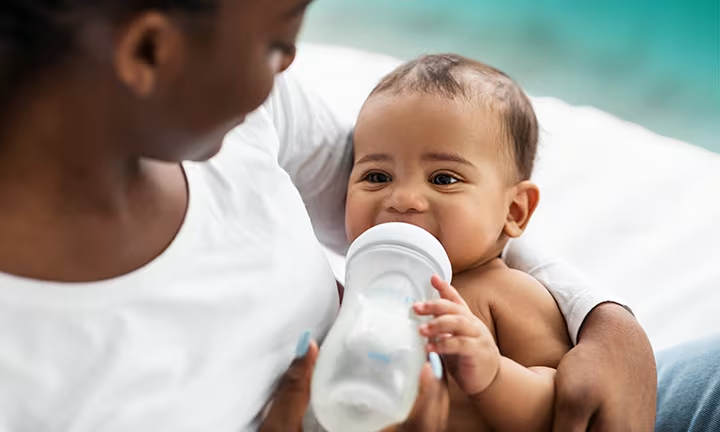
When Do Babies Hold Their Own Bottle or Cup?


You may be curious to know at what age do babies hold their own bottle or a cup, or you may be wondering how to teach or get your baby to hold a bottle or cup. There are a few developmental milestones your baby must reach before they can do this. It’s also important to know that leaving your baby alone with their bottle is dangerous—bottle-feeding should always be supervised. And even letting them drink from a cup should be done with supervision.
When Do Babies Start Holding Their Own Bottle or Cup?
Between the ages of 6 and 8 months, most babies acquire the necessary fine motor skills to be able to hold objects such as cups and bottles with their hands and fingers.
Here’s a month-by-month breakdown of how your baby may work on and eventually master the skill of holding a bottle or cup:
But drinking from a bottle or cup involves not only fine motor skills but also gross motor skills—skills that involve larger physical movements—which are needed for a baby to sit up independently. Sitting up on their own is a milestone they'll need to reach in order to begin feeding themselves solid food.
In other words, a combination of many development milestones enables your baby to hold onto a bottle or cup and drink from it.
Learn more about your baby’s development during these months.

Baby Growth Chart Calculator
Keep an eye on your baby’s average growth by tracking height, weight, and head circumference with our simple tool.
This is a mandatory field.
This is a mandatory field.
This is a mandatory field.
This is a mandatory field.
*Input details of your baby’s last measurements. **Source: World Health Organization
Transitioning From Bottle to Cup
Around the same time your baby would learn to hold on to a bottle is the recommended time for introducing a cup (or sippy cup ).
Whether you’ve bottle-fed your baby or exclusively breastfed your baby, experts recommend weaning directly to a cup as early as 6 months old. That means there would be no reason to teach your baby to hold a bottle. The six-month mark is also the time where you can start giving your baby water in a cup. Giving your baby water would be in addition to continued breastfeeding or formula-feeding; however, you’d still want to avoid cow’s milk until your baby turns 1 and avoid giving your baby juice altogether.
Guidelines for Safe Bottle-Feeding
Even if your baby can hold their own bottle, that doesn’t mean that your baby should hold their own bottle. You may be tempted to let them hold the bottle themselves, or, if they’re not yet wholly adept at holding the bottle, to try a practice called “bottle-propping” using a device called a bottle propper. This practice and this type of device should be avoided for several reasons.
First, feeding time is an opportunity to bond with your baby, so you’d be missing out on an important moment with your little one if you're not directly participating in the process.
Second, it’s dangerous to leave your baby alone with a bottle. They could fall asleep with the bottle in their mouth, which can lead to
The safest practice is to never leave your baby alone with their bottle.
FAQs at a Glance
No, at 3 or 4 months old, a baby doesn't have the ability to start holding a bottle or cup. This typically happens between 6 and 8 months old. Around the time your baby turns 18 months old, they will likely be able to drink from a cup, hold it, and put it back down.
The Bottom Line
If you’re wondering when do babies hold their own bottle, it's helpful to know that many babies are able to hold a bottle and/or a cup at around 6 to 8 months old. If your little one has acquired this skill, or is working on it, be sure not leave your baby unattended with a bottle or cup. For one thing, they aren't yet able to keep holding a bottle or cup without dropping it. Your supervision is still required to help your baby feed from a bottle or drink from a cup.
Even more important is that it’s not safe to leave your baby unsupervised with their bottle. And it’s not a good idea to prop your baby’s bottle on any object or to use a bottle propper device. Leaving your baby alone with their bottle can lead to them falling asleep with the bottle in their mouth, which is connected to tooth decay and ear infections, and can even lead to choking.
Use bottle-feeding as an opportunity to bond with your baby. Don’t use this time to multitask or to leave your baby unattended. And, since experts recommend beginning weaning to a cup around 6 months of age, there’s no reason you should teach your baby to hold their bottle, since there will be no need for the bottle soon enough.
In the meantime, you’ll be helping your baby learn to hold a cup and drink from it, which they will eventually be able to do all by themselves!
Are you curious about learning more about your child's development? In the Pampers Rewards app, you can follow along with your child's month-by-month development while also earning Pampers Cash for all the diapers you buy. Just scan the diaper code, most boxes have two, earn $10 Pampers Cash after 10 diaper scans, and redeem for $$ off Pampers at one of your favorite retailers.
- American Academy of Pediatrics. Caring for Your Baby and Young Child: Birth to Age 5, 7th ed. (New York: Bantam Books, 2019).
- American Academy of Pediatrics. Heading Home With Your Newborn: From Birth to Reality, 3rd ed. (Elk Grove Village, IL: American Academy of Pediatrics, 2015).
- American Academy of Pediatrics. The Wonder Years (New York: Bantam Dell, 2006).
- Dixon, Suzanne D., and Stein, Martin T. Encounters With Children, 3rd ed. (St. Louis, MO: Mosby, 2000).
- Phoenix Children’s Hospital. “Always Hold the Baby Bottle.”
- UCSF Benioff Children’s Hospitals. “FAQ: Baby Bottle Weaning.”

When Do Babies Roll Over? How to Encourage It
By Christopher B. Peltier
You might be wondering, when do babies start rolling over. Find out at what age it typically happens and how to help and encourage it.
Read more
When Do Babies Start Walking? Signs, Tips, and Milestones
By Christopher B. Peltier
Find out the typical age babies start walking, signs they’re ready, tips to encourage their first steps, and when to consult a healthcare provider about milestones.
Read more
What Is Object Permanence and When Do Babies Understand It?
By Christopher B. Peltier
Grasping the concept of object permanence is an important part of your baby’s cognitive development. Learn more about what object permanence is here.
Read more
Everything You Need to Know About Well-Baby Visits
Well-child visits are the regular checkups your child has throughout childhood. Discover the well-child checkup schedule, and what happens at each visit.
Read more
When, What, and How Far Can Newborns See—Including Colors?
By Christopher B. Peltier
From birth, babies use their eyes to discover the world around them! Get all the details on when and how far newborns can see, when they see color, and more.
Read more
All About Baby Growth Spurts: Signs, Timing, & Support
By Christopher B. Peltier
Learn all about baby growth spurts—signs, timing, and tips for supporting your little one through these rapid growth phases.
Read more
Moro Reflex in Babies: What It is and How to Manage It
By Christopher B. Peltier
Understand the Moro reflex, a natural startle response in infants, with tips to manage it effectively and guidance on when to consult a healthcare provider.
Read more
When Do Babies Start Clapping, Waving, and Pointing?
By Christopher B. Peltier
Learn when babies reach developmental milestones like clapping, waving, and pointing. Explore their growth journey and the best nurturing tips here.
Read more
All About Newborn, Infant, Baby, and Toddler Age Ranges
Learn about the differences between a newborn, infant, baby, and toddler, including the age ranges for each stage and more.
Read more
When Do Babies’ Eyes Change Color?
Learn when babies’ eyes change color and how genetics influences the final color, plus check out our baby eye color chart.
Read moreWhen Do Babies Roll Over? How to Encourage It
By Christopher B. Peltier
You might be wondering, when do babies start rolling over. Find out at what age it typically happens and how to help and encourage it.
Read moreWhen Do Babies Start Walking? Signs, Tips, and Milestones
By Christopher B. Peltier
Find out the typical age babies start walking, signs they’re ready, tips to encourage their first steps, and when to consult a healthcare provider about milestones.
Read moreWhat Is Object Permanence and When Do Babies Understand It?
By Christopher B. Peltier
Grasping the concept of object permanence is an important part of your baby’s cognitive development. Learn more about what object permanence is here.
Read moreEverything You Need to Know About Well-Baby Visits
Well-child visits are the regular checkups your child has throughout childhood. Discover the well-child checkup schedule, and what happens at each visit.
Read moreWhen, What, and How Far Can Newborns See—Including Colors?
By Christopher B. Peltier
From birth, babies use their eyes to discover the world around them! Get all the details on when and how far newborns can see, when they see color, and more.
Read moreAll About Baby Growth Spurts: Signs, Timing, & Support
By Christopher B. Peltier
Learn all about baby growth spurts—signs, timing, and tips for supporting your little one through these rapid growth phases.
Read moreMoro Reflex in Babies: What It is and How to Manage It
By Christopher B. Peltier
Understand the Moro reflex, a natural startle response in infants, with tips to manage it effectively and guidance on when to consult a healthcare provider.
Read moreWhen Do Babies Start Clapping, Waving, and Pointing?
By Christopher B. Peltier
Learn when babies reach developmental milestones like clapping, waving, and pointing. Explore their growth journey and the best nurturing tips here.
Read moreJoin a World of Support
through Pregnancy and Parenthood.
TRACK WITH TOOLS
LEARN WITH EXPERTS
GET REWARDED




Where You Already Belong