
Month 1
of pregnancy

You are 3% through your pregnancy, with your due date in 39 weeks
Fetal development
Height
~0.25 in
Weight
Monthly highlights
- 1Baby’s Development. In the first month, the fertilized egg implants in the uterus, and rapid growth begins. Cells form the embryo, placenta, and umbilical cord. By the end of this month, your baby (still called an embryo) is about the size of a pumpkin seed—around ¼ inch long.
- 2Bodily Changes & Symptoms. Some people feel no symptoms yet, while others notice fatigue, breast tenderness, nausea, bloating, mood swings, or light spotting from implantation. A missed period is often the first sign. Constipation and food aversions can also appear.
- 3Health & Wellness. Stay hydrated, eat fiber-rich foods, and try light exercise to ease bloating and constipation. Ginger or small, frequent meals may help with nausea. Home pregnancy tests are usually accurate the day after a missed period, but confirm results with your provider.
- 4Tips & To-Dos. Choose a prenatal care provider, schedule your first visit, and begin or continue prenatal vitamins with folic acid. Quit smoking and alcohol, manage stress, and rest when you can. Consider when you’d like to share your news, and learn the early signs of complications such as ectopic pregnancy.
You are 3% through your pregnancy, with your due date in 39 weeks
Checklist for month 1
- Research and select a prenatal healthcare provider.
- Confirm your pregnancy by taking a home pregnancy test. Read about the pregnancy hormone hCG as it’s what most home pregnancy tests work to detect.
- Arrange a doctor’s checkup. Your healthcare provider will confirm your pregnancy and give you guidance on the appointments you’ll need to keep over the coming months.
- Speak to your provider about pregnancy nutrition and whether you need to take any prenatal vitamins, such as folic acid.
- Download our complete guide to exercising while pregnant, which is brimming with helpful tips, and ask your healthcare provider about what type of exercise is right for your situation. Exercise can help you get a better night’s sleep and can also help with pregnancy body aches and pains.
- Quit unhealthy habits like smoking and drinking, and try to reduce stress.
- Although rare, it’s a good idea to read up on the signs of an ectopic pregnancy – just in case.
- Rest up whenever you can.
- If your partner doesn’t know you are pregnant yet, check out our fun ideas for how to announce your pregnancy to your partner.
- Speak to your loved ones about how you are feeling. This can be an emotional time, and you might be feeling all kinds of physical symptoms and pregnancy emotions that it may be best to share.

Loyalty program
Are you starting to think about buying the first diapers for your baby?
Get exclusive recommendations and offers just for you to save hundreds of $$$ on Pampers

Get the Pampers Rewards app
Key Takeaways
You might have noticed some changes in your body and started to wonder, “Could I be … pregnant!?” Or, you might not have observed any signs of pregnancy other than your period being late. If you have your suspicions, you'll probably want to take a home pregnancy test. If the result is positive, congratulations! Read on to find out more about early pregnancy symptoms, how your baby is developing when you’re one month pregnant, and what else is in store for you this month.
Common Pregnancy Symptoms at 1 Month Pregnant
At one month pregnant, you may not experience many — or any — symptoms. However, some of the early signs of pregnancy at one month pregnant can include:
How Is Your Baby Developing This Month?
After conception, the fertilized egg travels along the fallopian tube to the uterus, where it will implant in the uterine lining. The egg divides into a bunch of cells, some of which become the embryo and some of which eventually become the placenta, which will provide nourishment for your baby during your pregnancy. The umbilical cord also forms between the embryo and the placenta, delivering nutrients and removing waste. The upcoming month is a time of rapid growth for your little one, as internal organs, bones, and tiny limbs are beginning to form. One quick note on the terminology you might see when reading up on baby development: During the first eight weeks, your little one may be referred to as an embryo in medica circles, whereas after this point your baby may be called a fetus until she is born.
How Big Is Your Baby When You’re 1 Month Pregnant?
At this stage your baby is teeny-tiny, but by the start of the second month of pregnancy your little one will be about ¼ of an inch long – or about the size of a pumpkin seed.
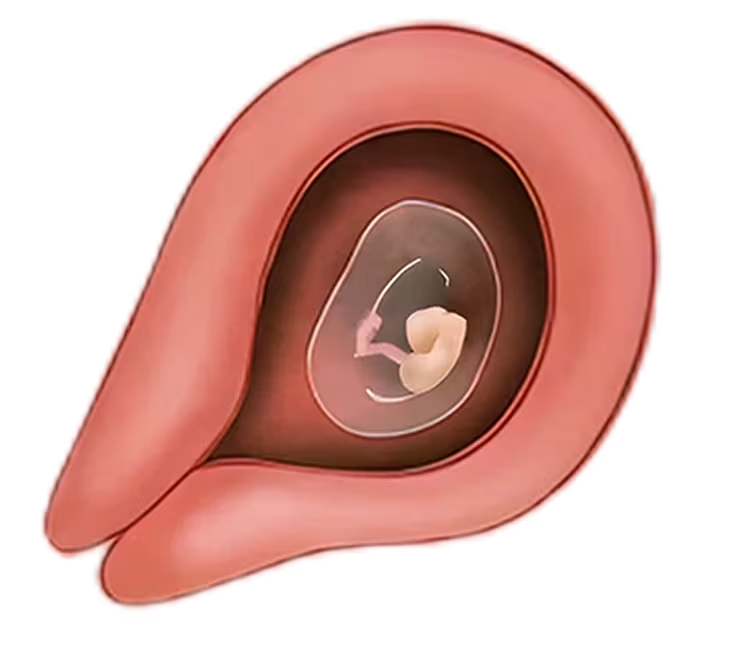
What Does an Embryo Look Like at 1 Month?
For a glimpse at how your little one might be looking inside your belly at 4 weeks, take a look at this illustration:
Changes to Your Body at 1 Month Pregnant
You probably won’t be noticing any changes to your body just yet, but that doesn’t mean there isn’t a lot going on under the surface. At this point, it’s important to prepare your body for pregnancy and childbirth by paying attention to your overall health and nutrition. This often means taking a multivitamin supplement to make sure you have all the nutrients you and your little one will need for the months ahead. Talk to your healthcare provider at your first prenatal visit to make sure you’re getting the right amounts of the right vitamins. It can also be helpful to begin or continue an exercise routine this month. Check in with your provider to make sure your favorite activities are safe during pregnancy, but in general, getting regular exercise can help build the strength and endurance you’ll need throughout your pregnancy.
How Far Along Are You at 1 Month Pregnant?
At one month pregnant, you’re at the start of the first trimester. Though there is no standard way of grouping pregnancy weeks into months (as they don't fit evenly), the first month usually includes week one through week four of pregnancy. The breakdown of weeks into trimesters also varies; here is a common method we'll follow: First trimester: 1 to 13 weeks Second trimester: 14 to 27 weeks Third trimester: 28 to 40 weeks (or until you give birth)
How Is Your Due Date Calculated?
At one month pregnant, you’ll be eager to know when your newborn will arrive. Our Due Date Calculator can give you an estimate, but your healthcare provider may be able to give you a more accurate date. Your due date is calculated as 40 weeks, or 280 days, from the first day of your last menstrual period. Keep in mind that your due date is just an estimate. You may not remember the date of your last period; the length of your menstrual cycle may be shorter or longer than the 28-day average; and it’s very difficult to know exactly when ovulation or fertilization occurred. Keep in mind, only a small percentage of babies are born exactly on their due date and most babies are born in the two weeks either side of their due date.
FAQs at a Glance
Home pregnancy tests are designed to detect the pregnancy hormone hCG in your urine. Typically, these tests claim to work from the day after the first day of your missed period, but some brands are more sensitive than others.
Checklist for When You’re 1 Month Pregnant
- Book: Your Pregnancy and Childbirth: Month to Month, Sixth Edition Paperback – January 1, 2016 by American College of Obstetricians and Gynecologists (Author)
- ACOG: Methods for Estimating the Due Date
- ACOG: How your fetus grows during pregnancy
- Kids Health: Word! Umbilical Cord
- Cleveland Clinic: Fist Trimester
- Mayo Clinic: Symptoms of pregnancy: What happens first
- Kids Health: Pregnancy precautions
- Mayo Clinic: 1st trimester pregnancy: What to expect

Month 8
At eight months pregnant, you might have some uncomfortable symptoms and also be busy preparing for your baby’s birth. Learn more about what’s in store this month.
Read more
Month 9
This is an exciting month as you’ll finally get to meet your baby. Learn more about what may be in store for you when you’re nine months pregnant.
Read more
Month 2
At two months pregnant, you might get symptoms like morning sickness. Learn more about this as well as baby development and what else is in store this month.
Read more
Month 3
By Leigh Lindsey
At three months pregnant, you’re nearing the end of the first trimester. Learn about some of the common symptoms, and about your baby’s development.
Read more
Month 4
You’ve made it to the “honeymoon” trimester of pregnancy. At four months pregnant, some of your early pregnancy symptoms may subside. Learn more here.
Read more
Month 5
At five months pregnant, you’re at the halfway mark and might even have an ultrasound scheduled. Discover everything that happens in the coming weeks.
Read more
Month 6
At six months pregnant, use the tail-end of the second trimester to get the nursery ready or take a babymoon. Learn more about this exciting month here.
Read more
Month 7
At seven months pregnant, your growing bump may be causing you some discomfort. Find out more about pregnancy symptoms and baby development here.
Read moreMonth 8
At eight months pregnant, you might have some uncomfortable symptoms and also be busy preparing for your baby’s birth. Learn more about what’s in store this month.
Read moreMonth 9
This is an exciting month as you’ll finally get to meet your baby. Learn more about what may be in store for you when you’re nine months pregnant.
Read moreMonth 2
At two months pregnant, you might get symptoms like morning sickness. Learn more about this as well as baby development and what else is in store this month.
Read moreMonth 3
By Leigh Lindsey
At three months pregnant, you’re nearing the end of the first trimester. Learn about some of the common symptoms, and about your baby’s development.
Read moreMonth 4
You’ve made it to the “honeymoon” trimester of pregnancy. At four months pregnant, some of your early pregnancy symptoms may subside. Learn more here.
Read moreMonth 5
At five months pregnant, you’re at the halfway mark and might even have an ultrasound scheduled. Discover everything that happens in the coming weeks.
Read moreMonth 6
At six months pregnant, use the tail-end of the second trimester to get the nursery ready or take a babymoon. Learn more about this exciting month here.
Read moreMonth 7
At seven months pregnant, your growing bump may be causing you some discomfort. Find out more about pregnancy symptoms and baby development here.
Read more